-Spoken by a dude to a chick after sitting at a table with her without saying a word for nearly a minute.
Saturday, May 30, 2009
Overheard at Cafe Coco
-Spoken by a dude to a chick after sitting at a table with her without saying a word for nearly a minute.

Thursday, May 28, 2009
Friday, May 15, 2009

My Own Better Late Than Never

I am going to steal a page from the AV Club, and write about my Better-Late-Than-Never movie: Highlander.
I never considered myself a big sci-fi fan. I grew up watching Star Wars and E.T. But I never actively sought out sci-fi movies or books. In fact, I generally avoided them. Horror movies I loved. The visceral thrill of watching somebody claw their way througha life-or-death situation was always enticing to me, but the heady nature of sci-fi held no appeal. Aliens were silly, and I was not someone easily impressed with rocket ships or lasers. Also, I couldn’t stand Arnold Schwarzenegger. I didn’t follow The X-Files or Star Trek. I didn’t care for The Matrix. But a creeping realization dawned on me over the last decade. I found myself drawn more and more to sci-fi. My first clue appeared while I was waiting in line to see Episode One. It wasn’t unusual for me to sit in a line to see a movie. I see at least two movies every weekend, and rarely skip big event movies. What alarmed me was the fact that I was reading 1984 while waiting in line. Reading a sci-fi book while waiting to see a sci-fi movie screams nerd – despite the fact that I shrugged it off as funny timing.
But over the last decade, I became more and more attracted to sci-fi movies and television. A.I. and Minority Report. The Iron Giant. Children of Men. The Prestige. Battlestar Galactica. And most notable of all, Lost. I went back and re-evaluated Blade Runner and Brazil. I never fully caught up with The X-Files, but I’ve seen more now than I had before the show ended. Eventually, I embraced my love for sci-fi. Both sci-fi and horror are inherently allegorical genres – even when the filmmakers don’t intend them to be. That’s the nature of the beast. And I can watch monsters ghosts, robots and aliens rape, kill and pillage without feeling any of the heaviness and weight of watching a historical holocaust film. Death and disaster in these movies are harmless, exciting, and guilt-free.
There’s a lot of sci-fi I haven’t yet caught up on, but I feel like I’ve hit most of the heavy hitters. But my attention was brought to a gaping hole in my sci-fi canon when one particular movie was referenced on an episode of The Venture Brothers. Highlander. How had Highlander escaped my eyes for so long? Well, part of the reason is because I remember seeing the trailer for Highlander 2 when it first came out. My thoughts at the time: What the fuck is Highlander? And wow, that looks terrible. Thusly, I avoided anything Highlander for well over a decade.
Well, that’s been remedied. Unfortunately, Highlander turns out to be a fantasy, which is a genre I have not warmed to yet.
Highlander is a creature of the eighties, through and through. From its cheesy rock score to its gritty artificiality, everything about this movie reveals its age. The sets are punctuated with steamy warehouses and rain-washed streets. The hair is high. The special effects are “charming”. And the studio apartments are oversized (complete with giant fish tanks!). It was released two years after The Terminator, and the movie is clearly inspired by Cameron’s thriller. Both are low budget movies about other worldly warriors, and the woman caught up in their fight. But while The Terminator is a taut economical thriller with hardly a wasted moment, Highlander meanders and shuffles toward its end. There is little sense of urgency, robots are nowhere to be seen, and the stakes are spoken of in the vaguest of terms. So what does highlander have that The Terminator doesn’t? Swords! But movie sword fighting choreography has come a long way in the last twenty years. Watching two people cautiously poke their swords at each other just isn’t as thrilling as it once was.
Christopher Lambert plays the lead character. He speaks in an accent that falls somewhere between William Wallace and Dracula. When he smiles, his face forms a freakish Cro-Magnon mask. His charisma is nil. Clancy Brown plays the hunter – tracking Lambert with a cackling laugh and hulking frame. Brown brings his best game and creates a character that is all id and clear out a church with just his over-ripe dialogue and evil laughter. Not even Sean Connery’s glorified cameo brings as much class to this mess. 4,00 year-old Connery shows up in Lambert’s flashbacks and barks a bunch of ambiguous exposition while finding increasingly extreme locations to hold their training montage at - the most shameful of which is the race at the beach.
As someone who sees connections to Lost everywhere he looks, I nearly outdid myself watching Highlander (especially in light of the recent season finale). The structure of Highlander very closely resembles any given episode of Lost. The storiy oscillates between Christopher Lambert in the present, and Christopher Lambert in the past. Deep in the past. Over a hundred years ago. In the flashbacks, we see Lambert get murdered, only to come back from death. Connery mysteriously shows and reveals that Lambert is immortal – unless of course his head is severed from his neck. He raves about quickenings and gatherings. And repeats that there can only be one. As the centuries pass, Lambert dies in a gay duel and saves a little girl from Nazis.
In the present, a big-haired female professional slowly learns the truth about Lambert who woos her in his creepy, macho eighties way. As they date, there are mysterious killings, excessive eye lights, grainy blue-tinged cinematography and a silhouetted love scene. Eventually, there is a sword fight, animated lightning, and visible wires. When there is only one, that one receives the quickening, which is “complete universal knowledge.” What does the winner do with complete universal knowledge? He apparently goes shopping at JC Penny and finds a pink sweater and white slacks to wear around the house.
And so, Highlander proves not to be the essential bit of eighties sci-fi I expected. It falls into that eighties abyss of wizards-and-shit-fantasy that portends sci-fi elements, but delivers only a mangled supernatural mythology (I’m looking at you, Ladyhawke!). I’m glad I can scratch it off of my list of movies to see, but I’m disappointed it wasn’t more engaging or eye-opening. It’s not referenced that much in popular culture, but if The Venture Brothers is going to give it a shout out, the least can do is sit down and watch it. And I’ll be damned if somebody didn’t make a Highlander reference just a few days later. Not a great or trailblazing movie, but seen widely enough to be recognizable and mocked. I have been advised to see Highlander 2: The Quickening – the ORIGINAL VERSION before the director attempted to edit/wrestle it into something more cohesive. Sadly the original batshit cut is hard to come by. It could only improve upon the experience of a merely serviceable first film.
There can only be one.
Monday, May 4, 2009
1934 It Happened One Night
A friend of mine has decided to watch all the Best Picture Oscar Winners in chronological order. A small group of people are joining him - including myself. Here are a few of the comments made at this year's movie.


- “They’re in love.” “Not yet!”
- “He probably shouldn’t be smoking near all that hay.”
- “Is it just me or are his pants really high?”
- “Yay. Finally a good one.”
Sunday, May 3, 2009
Parade of Death and Misery
I have always been drawn to that particular sub-genre of horror in which a group of people journey to a foreign location, only to encounter an evil native “force” that kills off the travelers one by one. After reading Scott Smith’s The Ruins last year, I became even more fascinated with this parade-of-death-and-misery story-telling. How did it come to be? How are these movies different and similar? My plan is to start rewatching many of these movies and eventually stumble on what makes them so resonant with audiences.
Where am I starting? What I currently assume to be the beginning: The Texas Chain Saw Massacre.
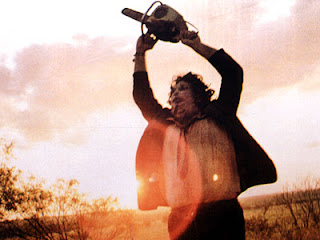
Number of Travelers: Five teens.
Destination: A cemetery that has been recently desecrated. Two of the teens have a grandfather who had been buried there, and they arrive to insure his remains were unharmed. Afterwards, the group travel to the abandoned homestead of said grandfather and chill. The other three are all just along for the ride.
Tragic Flaw to be Punished: The idea of sex and drugs equaling death had not yet been set up. While the kids are not portrayed as paradigms of integrity, nothing they do in the movie can be directly linked to the storm that follows. Each character is equally unlikeable.
Nature of Evil: A family of cannibals. One of whom wears a mask of skin and wields a chain saw. They live in isolation with only a single gas station as a beacon of civilization. Unfortunately, the station is run by the head of said family. This family in turn inspired the films of Rob Zombie, who romanticized his villains a bit much for my taste.
Dashed Hopes and Dreams: None of the teens express any interest in the future.
Final Survivors: One final girl.
Fate of Evil: As far as the story is concerned, the family lives on to terrify again. The final scene involves Leatherface swinging his chain saw wildly in the middle of the road.
Iconic moment: When I watched this in a theater last weekend, the audience clapped when Leatherface made his entrance – clubbing the first victim on the head and slapping his metal door shut. But for me, I love the slow tracking shots that follow characters as they roam about the area – often following at ass-level.
Where am I starting? What I currently assume to be the beginning: The Texas Chain Saw Massacre.

Number of Travelers: Five teens.
Destination: A cemetery that has been recently desecrated. Two of the teens have a grandfather who had been buried there, and they arrive to insure his remains were unharmed. Afterwards, the group travel to the abandoned homestead of said grandfather and chill. The other three are all just along for the ride.
Tragic Flaw to be Punished: The idea of sex and drugs equaling death had not yet been set up. While the kids are not portrayed as paradigms of integrity, nothing they do in the movie can be directly linked to the storm that follows. Each character is equally unlikeable.
Nature of Evil: A family of cannibals. One of whom wears a mask of skin and wields a chain saw. They live in isolation with only a single gas station as a beacon of civilization. Unfortunately, the station is run by the head of said family. This family in turn inspired the films of Rob Zombie, who romanticized his villains a bit much for my taste.
Dashed Hopes and Dreams: None of the teens express any interest in the future.
Final Survivors: One final girl.
Fate of Evil: As far as the story is concerned, the family lives on to terrify again. The final scene involves Leatherface swinging his chain saw wildly in the middle of the road.
Iconic moment: When I watched this in a theater last weekend, the audience clapped when Leatherface made his entrance – clubbing the first victim on the head and slapping his metal door shut. But for me, I love the slow tracking shots that follow characters as they roam about the area – often following at ass-level.
Ironic Understatement: "If I have any more fun today, I don't think I can take it."
What stands out: It was the first (as far as I can tell). It was a visceral, unrelenting attack on innocent people who were just minding their own business. The evil seemed to enjoy their tormenting so much. And the violence was/is so graphic.
Its Weakness: The characters are paper-thin and barely stand out from each other. Only the poor shlub in the wheelchair has any real personality.
Final Verdict: This movie is a visceral, disturbing romp through an endless sweaty afternoon and a terrifying night. Clearly, that’s the appeal. There is little more terrifying than watching someone being chased through the night by a lunatic with a chain saw. Perhaps there was also something in the fact that the killers are generally older than the victims. And the murderous activities were being passed down from generation to generation. A creepy observation by the filmmakers.
Part of my exploration will be an attempt to find their literary precedent. Surely, this type of story was not born out of seventies exploitation. I am beginning with ancient Greek mythc – particularly any journeys to the Underworld (i.e. Orpheus). However, the major difference with using ancient myths as the precedent is the fact that those embarking on the journey always know what they are in for as they set out. They are never surprised to find something evil on their mission. They also set-out with the set purpose to face said evil. In addition to that, the hero usually defeats the evil and survives – only to encounter a terrible fate later.
This genre really did seem to come out of nowhere. No rhyme or reason to the death. No lessons to be learned. The only warning the audience receives is the title (and those opening shots of the corpses). Texas Chain Saw Massacre emphasized the randomness of death.
What stands out: It was the first (as far as I can tell). It was a visceral, unrelenting attack on innocent people who were just minding their own business. The evil seemed to enjoy their tormenting so much. And the violence was/is so graphic.
Its Weakness: The characters are paper-thin and barely stand out from each other. Only the poor shlub in the wheelchair has any real personality.
Final Verdict: This movie is a visceral, disturbing romp through an endless sweaty afternoon and a terrifying night. Clearly, that’s the appeal. There is little more terrifying than watching someone being chased through the night by a lunatic with a chain saw. Perhaps there was also something in the fact that the killers are generally older than the victims. And the murderous activities were being passed down from generation to generation. A creepy observation by the filmmakers.
Part of my exploration will be an attempt to find their literary precedent. Surely, this type of story was not born out of seventies exploitation. I am beginning with ancient Greek mythc – particularly any journeys to the Underworld (i.e. Orpheus). However, the major difference with using ancient myths as the precedent is the fact that those embarking on the journey always know what they are in for as they set out. They are never surprised to find something evil on their mission. They also set-out with the set purpose to face said evil. In addition to that, the hero usually defeats the evil and survives – only to encounter a terrible fate later.
This genre really did seem to come out of nowhere. No rhyme or reason to the death. No lessons to be learned. The only warning the audience receives is the title (and those opening shots of the corpses). Texas Chain Saw Massacre emphasized the randomness of death.
Tuesday, April 28, 2009

Monday, April 27, 2009
Graffiti
"It's Monday and I'm a little drunk."
"I am angry at socks."
-Random graffiti by the urinal at Bongo JavaWednesday, April 22, 2009
God is Dead
A few months ago, I began to wonder what were some milestones in atheist cinema. After some exhaustive searches, I have found no satisfactory lists of atheist films. There seem to be a lot of movies that challenge the hypocrisy of religious institutions, but don’t necessarily challenge the existence of God. There are many movies that come off as nihilist, but believing in nothing is not the same as believing the world is naturally occurring, and understanding that it is up to us to create our own moral codes, rather than insisting that they have been handed down by some supernatural deity. And there are numerous movies that might be read as metaphorically atheist, but since no one seems to have stepped up to sort out how films depict religious beliefs, I have no guide to tell me how to recognize an atheist film. Apparently, it is up to me to work out the machinations of atheist story-telling myself. My search is very meta.
 Here is a list of atheist candidates. Some were arrived at on my own. Some were suggestions. I will continue pondering this indefinitely.
2001: A Space Odyssey
God, as an alien invader. Apes encounter God. Apes become man. Man creates Hal. Hal becomes God and attempts to kill man. Man, in turn, kills Hal. Man then encounters original God (a.k.a. the aliens). Then becomes space baby. Or not. Who am I?
Chocolat
This movie is about pagans, and doing such anti-Christian things as eating chocolates. Also, this movie is silly, silly, silly.
Contact
“I think, as a scientist, I’ve already answered that question.”
 Here is a list of atheist candidates. Some were arrived at on my own. Some were suggestions. I will continue pondering this indefinitely.
 2001: A Space Odyssey
God, as an alien invader. Apes encounter God. Apes become man. Man creates Hal. Hal becomes God and attempts to kill man. Man, in turn, kills Hal. Man then encounters original God (a.k.a. the aliens). Then becomes space baby. Or not. Who am I?
Chocolat
This movie is about pagans, and doing such anti-Christian things as eating chocolates. Also, this movie is silly, silly, silly.
Contact
“I think, as a scientist, I’ve already answered that question.”
According to rumor, Jodie Foster is an atheist, which makes me wonder why she would do a movie that is so irritatingly anti-skeptical. Perhaps she was taken in by the fact that her character is atheist and the author, Carl Sagan, was atheist. I kind of like Contact, in its own goofy way. It is so adamant about making its sci-fi story elements as believable as possible. But it buckles under Robert Zemeckis’ overbearing, tacky direction. Ultimately, Foster’s character becomes wishy-washy under the seduction of God’s boy Matthew McConaughey. All the crafty character building yields to the one, preposterous question posed to Foster’s character, “Do you expect us to believe all this . . .on faith?” A not-so-subtle slap to skepticism.
The Contender
“I do not need God to tell me what are my moral absolutes.”
This movie is only incidentally about an atheist character. When it first comes up, it feels like only one more piece of ammunition in the bad guys’ arsenal. This character is a progressive’s dream. She’s pro-choice, feminist, intelligent, against the death penalty, probably vegan, and of course atheist. Oh, yes. She also has a spotless personal record. Normally, this kind of flawless character would grate on me as abnormally worshipful by the filmmakers. But they need to go so far over the top to make their point. An excellent example of an atheist character at the center of a movie.
Crimes and Misdemeanors
“In the absence of a God or something, he is forced to assume that responsibility himself . . .”
Woody Allen is a self-described atheist, but aside from a few . . . asides, he rarely expresses it in his movies. Crimes and Misdemeanors is the most shining anomaly. Two parallel stories. In both, characters come to a place where they realize there is no God. One decides to take advantage of the lack of divine retribution. The other, as the quote says, steps in to fill that void himself. A dark rumination on morality and existentialism. Bonus: the most awesome suicide note ever, in all of film.
Dinosaurs: The Greatest Story Ever Sold
"They're making all this potato stuff up. This is not the truth. They're just feeding you easy answers to pacify you. That way they can control your lives."
Remember that show in the early nineties, Dinosaurs? It was from Jim Henson studios and featured people dressed up as Dinosaurs? Pretty bad show, but this episode is brazingly atheist. It ruthlessly mocks religion and superstition. When dinosaurs start asking why are we here, a panel of judges comes up with potato-ism. Potato-ism is chosen because even the biggest idiot alive can understand its simplicity. I could take any quote from the episode and it is all relevant. "Dear Mr. & Mrs. Sinclair, Your son Robert was expelled from school today for rejecting all known belief and threatening to obliterate the foundation of social order." Sadly, this episode is overly optimistic. At the end, all the dinosaurs realize the "religious leaders slash government" is making all this potato stuff up.
The Contender
“I do not need God to tell me what are my moral absolutes.”
This movie is only incidentally about an atheist character. When it first comes up, it feels like only one more piece of ammunition in the bad guys’ arsenal. This character is a progressive’s dream. She’s pro-choice, feminist, intelligent, against the death penalty, probably vegan, and of course atheist. Oh, yes. She also has a spotless personal record. Normally, this kind of flawless character would grate on me as abnormally worshipful by the filmmakers. But they need to go so far over the top to make their point. An excellent example of an atheist character at the center of a movie.
Crimes and Misdemeanors
“In the absence of a God or something, he is forced to assume that responsibility himself . . .”
Woody Allen is a self-described atheist, but aside from a few . . . asides, he rarely expresses it in his movies. Crimes and Misdemeanors is the most shining anomaly. Two parallel stories. In both, characters come to a place where they realize there is no God. One decides to take advantage of the lack of divine retribution. The other, as the quote says, steps in to fill that void himself. A dark rumination on morality and existentialism. Bonus: the most awesome suicide note ever, in all of film.
Dinosaurs: The Greatest Story Ever Sold
"They're making all this potato stuff up. This is not the truth. They're just feeding you easy answers to pacify you. That way they can control your lives."
Remember that show in the early nineties, Dinosaurs? It was from Jim Henson studios and featured people dressed up as Dinosaurs? Pretty bad show, but this episode is brazingly atheist. It ruthlessly mocks religion and superstition. When dinosaurs start asking why are we here, a panel of judges comes up with potato-ism. Potato-ism is chosen because even the biggest idiot alive can understand its simplicity. I could take any quote from the episode and it is all relevant. "Dear Mr. & Mrs. Sinclair, Your son Robert was expelled from school today for rejecting all known belief and threatening to obliterate the foundation of social order." Sadly, this episode is overly optimistic. At the end, all the dinosaurs realize the "religious leaders slash government" is making all this potato stuff up.
The Golden Compass
The one kidnapped kid says something about the Gobblers promising to send kids home after some operation, but none of the kids ever come back. I can't remember the actual phrasing so I won't try to repeat it verbatim.
Groups were all up-in-arms about how this movie promotes atheism. I never got that from the one and a half books I read, and I still don't see it much in the movie. There's a little talk of the Magisterium wanting to control what people think. Any atheist agenda is purely anemic in the first volume. Maybe in later installments . . . if they make any more.
A friend's review: "There was no atheist message in that. At all!"
The one kidnapped kid says something about the Gobblers promising to send kids home after some operation, but none of the kids ever come back. I can't remember the actual phrasing so I won't try to repeat it verbatim.
Groups were all up-in-arms about how this movie promotes atheism. I never got that from the one and a half books I read, and I still don't see it much in the movie. There's a little talk of the Magisterium wanting to control what people think. Any atheist agenda is purely anemic in the first volume. Maybe in later installments . . . if they make any more.
A friend's review: "There was no atheist message in that. At all!"
Harold and Maude
“Do you pray?”
“Pray? No. I communicate.”
“With God?”
“With life!”
The only religion in the movie, per say, is the priest whose car Maude steals. There’s also a reference to Maude “painting a saint.” Rampantly counter-cultural and anti-establishment. Mostly Maude inspires nihilist Harold to embrace life and live it by his own morals by giving a parade of inspirational speeches. “Vice, virtue . . . It’s best not to be too moral. You cheat yourself out of too much life. Aim above morality. If you apply that to life, then you’re bound to live it fully.” Everything the filmmakers find dangerous is embodied in Harold’s mother, who believes that God can influence our lives and the military is a character builder. This movie best illustrates what I’m looking for in an atheist movie – illustrating how religious skepticism is not nihilistic, but rewarding in its own way.
 Inherit the Wind
“As long as the prerequisite for that shining paradise is ignorance, bigotry and hate, I say to hell with them!”
This is pretty much the only movie I can think of that has a real atheist agenda. The play based on the Scopes Monkey Trial. Calm reserved atheist Spencer Tracy versus radical fundamentalist Godfucker Frederic March fighting for the soul of “Hillsboro, Tennessee” – standing in for Dayton. The movie depicts religion as hateful, superstitious, and anti-progress – while the theory of evolution is the future. Decidedly pro-science. Until the last five minutes, when the movie does an about-face and secretly Christian Tracy rips atheist Gene Kelly a new one – saying he believes in nothing and will die lonely. Tracy then weighs Darwin’s book and the Bible in his hands and firmly places the Bible on top of Darwin’s book. A complete betrayal of everything that had come earlier in the movie. It starts off incredibly ballsy and then freaks itself out. “You killed one of their fairy tale notions.”
It’s the Great Pumpkin, Charlie Brown
“Don’t take it bad. I’ve done a lot of stupid things in my life, too.”
Linus sits in a pumpkin patch all night – waiting for the Great Pumpkin to come. It does not. Even though Linus’ faith remains unwavering, it is clear to everyone around him he’s goddamn mental. Of course it takes some kind of fake mythological thing like the Great Pumpkin to make this point. It were even something as innocuous as a kid waiting up for Santa Claus, you know there would be at least some hint of his faith being rewarded.
Joshua
“So you love Jesus now . . . Go to bed!!”
Not really an atheist movie, but the “good guy” parents take offense when Grandma takes innocent little Joshua to church.
Life of Brian
This movie mocks group thinking and the need to latch onto any nut with a mount, but it takes for granted that Jesus is who he says he is. Curing lepers and whatnot. Not atheist. But definitely anti-organized religion.
Logan’s Run
“Life clocks are a lie! Carousel is a lie! There is no renewal!”
Metaphorical silliness. Maybe atheist.
 Love and Death
“What if we’re just a bunch of absurd people running around with no rhyme or reason?”
I just recently saw this movie from Woody Allen and it is amazing. Brazen in its politics – including an aversion to all things Godly. There are long, comically deep conversations about the existence of God and the subjectivity of morality and extensive musings on death and suicide. At one point, Allen is approached by a shadow introducing itself as an angel of God. The angel makes a wildly inaccurate prophecy - - cementing the movie’s atheist agenda. And there’s a parody of Persona to boot!
The Magdalene Sisters
“He’s not a man of God.”
This movie actually has nothing to do with faith, per say. It has everything to do with exposing religious hypocrisy wielding its morals like weapons in an effort to keep certain elements (namely women) in their place. A nun does get called a “fucking twisted bitch,” but no character ever really comes to accept a godless world.
The Maltese Falcon
“It’s the stuff that dreams are made out of.”
This one is purely metaphorical. It seems as if film noir would be prime for atheist movies because of its nihilistic characters. But the best I can think of, off the top of my head, is this one. Everyone is killing themselves trying to find this mystical treasure, and once they find it, they realize it’s a fake. So the search continues for some, while others (like Bogart’s Sam Spade) decide to opt out – staying true to what their own smarts tell them.
Ordinary People
“I don’t believe in God.”
“Not at all?”
“Nope. Well, it’s not a question of degree. Either you do or you don’t.”
Conrad Jarrett. High school atheist. One could argue he starts out as a nihilist, attempting to take his own life, but by the end of the film, he is on his way to believing in something, and as he states here, it’s not God.
Planet of the Apes
“Get your hands off me you damn dirty apes!”
Just because the apes talk, that doesn’t mean this is an atheist movie.
Quills
“Why should I love God? He strung up his only son like a side of veal. I shudder to think what he would do to me.”
The Marquis De Sade is not the greatest role model for atheists. But a pretty good satire.
Religulous
"If there's one thing I hate more than a prophecy, it's a self-fulfilling prophecy."
Bill Maher goes around mocking religous people. Thank god somebody's doing it.
Rosemary’s Baby
“God is dead!”
This movie operates under the concept that God does exist, or at least did at some point. This movie does make Satanism look pretty damn cool, but Satanism is not atheism.
 The Ruling Class
“How do you know you’re God?”
“Simple. When I pray to him, I find that I’m talking to myself.”
Peter O’Toole thinks he’s God. Even to the point of climbing up on a giant cross to take naps. His family introduces him to another nut named the Electric Christ. The Electric Christ shoots lightening out of his fingertips. O’Toole, conceding that they’re can’t be two Gods, decides he must be Jack the Ripper instead. More problems ensue. Throughout all this, characters sporadically burst into song and dance. There are many irreverent quips about the absence of God. The movie even goes so far as to suggest believing in God is somewhat insane. Not entirely atheist, but certainly divinely dubious.
Stalker
“Calling themselves intellectuals, those writers and scientists! They don’t believe in anything! . . . They know they were born for a purpose, called upon. After all, they “live only once.” Can people like that believe in anything?”
This movie drips with disdain for skepticism – as far as I can tell. When the dialogue takes a break from being enigmatic, it is vehemently anti-skeptic rhetoric. After the stalker collapses on the floor and sputters these lines, his wife comforts him by saying, “You ought to pity them. Not be angry with them.” In the end, dude’s wife turns to the camera and literally explains God’s plan. This movie is like a two-and-a-half hour sermon. By equating atheism with nihilism, this movie becomes exactly the kind of anti-atheist crap that irritates the hell out of me.
Star Trek V: The Final Frontier
“I need proof.”
Shatner et al. travel to a planet and find God, but he’s not really God. He’s just some poser. Shatner makes some goofy comment about God being in the human heart. The very existence of this movie should prove there is no god. Ugh!
Sunshine
“I talked to God for seven years. He told me to bring us all to Heaven.”
Alex Garland, the writer of Sunshine, The Beach (the novel), and 28 Days Later, describes himself as an atheist and has stated that he saw the story of a group of scientists on a mission to reignite the sun very differently than director Danny Boyle, who is not atheist. Regardless, the story still comes down to over-the-top religious fundamentalism versus science (be it the improbable sci-fi kind of science). I am happy to report that silly sci-fi beats crazy religious fundamentalism.
There Will Be Blood
"I am a false prophet and God is a superstition."
There's a lot going on in this movie, and Eli's relationship with God is the tip of the iceberg. I suppose it is up in the air whether Eli believes what he says, but regardless, I feel as if the movie is with Daniel on this issue. Well, at least up to a point. If there is a God, he's not paying attention to what's going on in this little town. There's not much goodness in this movie, and it might be more nihilistic than atheist, but I think PTA is deliberately calling out Eli on his exploitation of faith.
Through a Glass Darkly
"For you, love and God are the same."
Everybody is always telling me about how Ingmar Bergman is a big atheist, and all his movies are atheist films. That's bullshit. The man is obsessed with God. Ooh, God is a big spider seen by a crazy person. Bergman must be atheist. Bah! All his movies reek of you-don't-have-to-believe-in-organized-religion-as-long-as-you-believe-in-something.
Tombstone
“Remember what I said about seeing a light when you die . . . That ain’t true. I can’t see a damn thing.”
Look! Crumbs! Crumbs for the atheist!
Touching the Void
“I had always wondered if things really hit the fan whether I would, under pressure, turn around and say a few Hail Marys and say “Get me out of here . . . “ It never once occurred to me. It meant that I really don’t believe, and I really do think that when you die, you die. That’s it. There’s no afterlife. There’s nothing.”
You often hear people talk about how they turned to God and He saw them through some experience. You rarely hear from the people who turned to God and he didn't help them. That's because they're all dead. This quote is the entirity of atheist feelings expressed in the movie, but in the context of a man getting his ass kicked by nature and still coming out on top - all without even thinking to ask for divine deliverence - it makes for a very exciting and satisfying atheist parable.
“Do you pray?”
“Pray? No. I communicate.”
“With God?”
“With life!”
The only religion in the movie, per say, is the priest whose car Maude steals. There’s also a reference to Maude “painting a saint.” Rampantly counter-cultural and anti-establishment. Mostly Maude inspires nihilist Harold to embrace life and live it by his own morals by giving a parade of inspirational speeches. “Vice, virtue . . . It’s best not to be too moral. You cheat yourself out of too much life. Aim above morality. If you apply that to life, then you’re bound to live it fully.” Everything the filmmakers find dangerous is embodied in Harold’s mother, who believes that God can influence our lives and the military is a character builder. This movie best illustrates what I’m looking for in an atheist movie – illustrating how religious skepticism is not nihilistic, but rewarding in its own way.
 Inherit the Wind
“As long as the prerequisite for that shining paradise is ignorance, bigotry and hate, I say to hell with them!”
This is pretty much the only movie I can think of that has a real atheist agenda. The play based on the Scopes Monkey Trial. Calm reserved atheist Spencer Tracy versus radical fundamentalist Godfucker Frederic March fighting for the soul of “Hillsboro, Tennessee” – standing in for Dayton. The movie depicts religion as hateful, superstitious, and anti-progress – while the theory of evolution is the future. Decidedly pro-science. Until the last five minutes, when the movie does an about-face and secretly Christian Tracy rips atheist Gene Kelly a new one – saying he believes in nothing and will die lonely. Tracy then weighs Darwin’s book and the Bible in his hands and firmly places the Bible on top of Darwin’s book. A complete betrayal of everything that had come earlier in the movie. It starts off incredibly ballsy and then freaks itself out. “You killed one of their fairy tale notions.”
It’s the Great Pumpkin, Charlie Brown
“Don’t take it bad. I’ve done a lot of stupid things in my life, too.”
Linus sits in a pumpkin patch all night – waiting for the Great Pumpkin to come. It does not. Even though Linus’ faith remains unwavering, it is clear to everyone around him he’s goddamn mental. Of course it takes some kind of fake mythological thing like the Great Pumpkin to make this point. It were even something as innocuous as a kid waiting up for Santa Claus, you know there would be at least some hint of his faith being rewarded.
Joshua
“So you love Jesus now . . . Go to bed!!”
Not really an atheist movie, but the “good guy” parents take offense when Grandma takes innocent little Joshua to church.
Life of Brian
This movie mocks group thinking and the need to latch onto any nut with a mount, but it takes for granted that Jesus is who he says he is. Curing lepers and whatnot. Not atheist. But definitely anti-organized religion.
Logan’s Run
“Life clocks are a lie! Carousel is a lie! There is no renewal!”
Metaphorical silliness. Maybe atheist.
 Love and Death
“What if we’re just a bunch of absurd people running around with no rhyme or reason?”
I just recently saw this movie from Woody Allen and it is amazing. Brazen in its politics – including an aversion to all things Godly. There are long, comically deep conversations about the existence of God and the subjectivity of morality and extensive musings on death and suicide. At one point, Allen is approached by a shadow introducing itself as an angel of God. The angel makes a wildly inaccurate prophecy - - cementing the movie’s atheist agenda. And there’s a parody of Persona to boot!
The Magdalene Sisters
“He’s not a man of God.”
This movie actually has nothing to do with faith, per say. It has everything to do with exposing religious hypocrisy wielding its morals like weapons in an effort to keep certain elements (namely women) in their place. A nun does get called a “fucking twisted bitch,” but no character ever really comes to accept a godless world.
The Maltese Falcon
“It’s the stuff that dreams are made out of.”
This one is purely metaphorical. It seems as if film noir would be prime for atheist movies because of its nihilistic characters. But the best I can think of, off the top of my head, is this one. Everyone is killing themselves trying to find this mystical treasure, and once they find it, they realize it’s a fake. So the search continues for some, while others (like Bogart’s Sam Spade) decide to opt out – staying true to what their own smarts tell them.
Ordinary People
“I don’t believe in God.”
“Not at all?”
“Nope. Well, it’s not a question of degree. Either you do or you don’t.”
Conrad Jarrett. High school atheist. One could argue he starts out as a nihilist, attempting to take his own life, but by the end of the film, he is on his way to believing in something, and as he states here, it’s not God.
Planet of the Apes
“Get your hands off me you damn dirty apes!”
Just because the apes talk, that doesn’t mean this is an atheist movie.
Quills
“Why should I love God? He strung up his only son like a side of veal. I shudder to think what he would do to me.”
The Marquis De Sade is not the greatest role model for atheists. But a pretty good satire.
Religulous
"If there's one thing I hate more than a prophecy, it's a self-fulfilling prophecy."
Bill Maher goes around mocking religous people. Thank god somebody's doing it.
Rosemary’s Baby
“God is dead!”
This movie operates under the concept that God does exist, or at least did at some point. This movie does make Satanism look pretty damn cool, but Satanism is not atheism.
 The Ruling Class
“How do you know you’re God?”
“Simple. When I pray to him, I find that I’m talking to myself.”
Peter O’Toole thinks he’s God. Even to the point of climbing up on a giant cross to take naps. His family introduces him to another nut named the Electric Christ. The Electric Christ shoots lightening out of his fingertips. O’Toole, conceding that they’re can’t be two Gods, decides he must be Jack the Ripper instead. More problems ensue. Throughout all this, characters sporadically burst into song and dance. There are many irreverent quips about the absence of God. The movie even goes so far as to suggest believing in God is somewhat insane. Not entirely atheist, but certainly divinely dubious.
Stalker
“Calling themselves intellectuals, those writers and scientists! They don’t believe in anything! . . . They know they were born for a purpose, called upon. After all, they “live only once.” Can people like that believe in anything?”
This movie drips with disdain for skepticism – as far as I can tell. When the dialogue takes a break from being enigmatic, it is vehemently anti-skeptic rhetoric. After the stalker collapses on the floor and sputters these lines, his wife comforts him by saying, “You ought to pity them. Not be angry with them.” In the end, dude’s wife turns to the camera and literally explains God’s plan. This movie is like a two-and-a-half hour sermon. By equating atheism with nihilism, this movie becomes exactly the kind of anti-atheist crap that irritates the hell out of me.
Star Trek V: The Final Frontier
“I need proof.”
Shatner et al. travel to a planet and find God, but he’s not really God. He’s just some poser. Shatner makes some goofy comment about God being in the human heart. The very existence of this movie should prove there is no god. Ugh!
Sunshine
“I talked to God for seven years. He told me to bring us all to Heaven.”
Alex Garland, the writer of Sunshine, The Beach (the novel), and 28 Days Later, describes himself as an atheist and has stated that he saw the story of a group of scientists on a mission to reignite the sun very differently than director Danny Boyle, who is not atheist. Regardless, the story still comes down to over-the-top religious fundamentalism versus science (be it the improbable sci-fi kind of science). I am happy to report that silly sci-fi beats crazy religious fundamentalism.
There Will Be Blood
"I am a false prophet and God is a superstition."
There's a lot going on in this movie, and Eli's relationship with God is the tip of the iceberg. I suppose it is up in the air whether Eli believes what he says, but regardless, I feel as if the movie is with Daniel on this issue. Well, at least up to a point. If there is a God, he's not paying attention to what's going on in this little town. There's not much goodness in this movie, and it might be more nihilistic than atheist, but I think PTA is deliberately calling out Eli on his exploitation of faith.
Through a Glass Darkly
"For you, love and God are the same."
Everybody is always telling me about how Ingmar Bergman is a big atheist, and all his movies are atheist films. That's bullshit. The man is obsessed with God. Ooh, God is a big spider seen by a crazy person. Bergman must be atheist. Bah! All his movies reek of you-don't-have-to-believe-in-organized-religion-as-long-as-you-believe-in-something.
Tombstone
“Remember what I said about seeing a light when you die . . . That ain’t true. I can’t see a damn thing.”
Look! Crumbs! Crumbs for the atheist!
Touching the Void
“I had always wondered if things really hit the fan whether I would, under pressure, turn around and say a few Hail Marys and say “Get me out of here . . . “ It never once occurred to me. It meant that I really don’t believe, and I really do think that when you die, you die. That’s it. There’s no afterlife. There’s nothing.”
You often hear people talk about how they turned to God and He saw them through some experience. You rarely hear from the people who turned to God and he didn't help them. That's because they're all dead. This quote is the entirity of atheist feelings expressed in the movie, but in the context of a man getting his ass kicked by nature and still coming out on top - all without even thinking to ask for divine deliverence - it makes for a very exciting and satisfying atheist parable.
The Truman Show
“You never had a camera in my head!”
Religion is only once directly referenced in this movie. Truman's best friend looks at a sunset and says something about the big guy's paintbrush. Ultimately, he is talking about Ed Harris's character, who fancies himself God. He even introduces himself as "the creator [pregnant pause] of a television show." When Truman challenges him, Ed Harris goes so far as to nearly kill Truman in an effort to keep him complacent. The moment when Truman rejects Ed Harris is so awesome - mostly because it is done in such a public fashion - with "the whole world watching." This movie is awesome, and its allusions to Christianity are daringly obvious.
Viridiana
The movie attacks organized religion for its hypocrisy (among other targets), but never calls out God himself in anyway.
 The Wicker Man
“[God] is dead. Can’t complain. He had his chance. He blew it.”
Not only is this movie anti-Christian, it is ruthlessly so. It depicts man’s faith in God as impotent. And not just the Christian God, the pagan gods come off as just as absent. This movie depicts no atheist characters, only religious freaks with no God to protect them. It could be seen as nihilist, but it is so pointedly anti-theist.
Witchfinder General
“Keep it up, Master Webb. You’re doing God’s work.”
Vincent Price claims to be a man of God, but it is quite clear he’s just abusing his power. Declaring is enemies as witches (including a priest) and torturing them until they die, while war wages around them. There is nothing supernatural about those he kills and God never intervenes to stop him. Even the most heroic character is vengeful and bloodthirsty. This movie is bleak. In the end, there is nothing positive in the world depicted here. No innate goodness of man. No real morality. I find this movie more nihilistic than atheist.
The Wizard of Oz
“Pay no attention to the man behind the curtain!”
In the broadest, most desperate interpretation possible, this movie could be seen as atheist, but it reeks of fluffy faith to me.
“You never had a camera in my head!”
Religion is only once directly referenced in this movie. Truman's best friend looks at a sunset and says something about the big guy's paintbrush. Ultimately, he is talking about Ed Harris's character, who fancies himself God. He even introduces himself as "the creator [pregnant pause] of a television show." When Truman challenges him, Ed Harris goes so far as to nearly kill Truman in an effort to keep him complacent. The moment when Truman rejects Ed Harris is so awesome - mostly because it is done in such a public fashion - with "the whole world watching." This movie is awesome, and its allusions to Christianity are daringly obvious.
Viridiana
The movie attacks organized religion for its hypocrisy (among other targets), but never calls out God himself in anyway.
 The Wicker Man
“[God] is dead. Can’t complain. He had his chance. He blew it.”
Not only is this movie anti-Christian, it is ruthlessly so. It depicts man’s faith in God as impotent. And not just the Christian God, the pagan gods come off as just as absent. This movie depicts no atheist characters, only religious freaks with no God to protect them. It could be seen as nihilist, but it is so pointedly anti-theist.
Witchfinder General
“Keep it up, Master Webb. You’re doing God’s work.”
Vincent Price claims to be a man of God, but it is quite clear he’s just abusing his power. Declaring is enemies as witches (including a priest) and torturing them until they die, while war wages around them. There is nothing supernatural about those he kills and God never intervenes to stop him. Even the most heroic character is vengeful and bloodthirsty. This movie is bleak. In the end, there is nothing positive in the world depicted here. No innate goodness of man. No real morality. I find this movie more nihilistic than atheist.
The Wizard of Oz
“Pay no attention to the man behind the curtain!”
In the broadest, most desperate interpretation possible, this movie could be seen as atheist, but it reeks of fluffy faith to me.
Sunday, April 19, 2009
i am so proud of you and Afterschool
This weekend I saw two excellent movies.
The first really took me by surprise: Afterschool. Nominated for an Independent Spirit Award and directed by a guy helming his first full length movie, this movie hit me like a ton of bricks.
It plays something like Paranoid Park, but where Gus Van Sant would insert an emo song or skateboarding footage, director Bruno Campos inserts youtube footage. Rather than being cloaked in hoodies and low jeans, these characters wear preppie uniforms and loosened ties. The entire movie is a bit heavy handed in how it depicts today’s youth as media-saturated, catatonic monsters. But what it lacks in subtlety (never something I was all that interested in), it blows away with style. The angles are constantly off center and cutting off significant action (the director claimed this was to replicate security cameras and their ilk, i.e. this was done on purpose. Don't come crying to me that the director didn't know how to use a camera), the editing has an arresting rhythm, and the sound is punctuated by long silences of ambient emptiness. And there is one significant shot in general which reminds me of Michael Snow’s Wavelength in its cold detached depiction of sudden action in an empty room. This movie is all about the watched and the watchers. And it does it by making the audience active watchers – forcing them to participate or not.
For much of the movie, the main character’s face is regularly obscured. Either the camera is pointing at the back of his head, or it’s pointing in a different direction all together. As a result, the audience views much of the action as the characters does. The characters are very much like real high schoolers. Vapid, not in touch with themselves, self-obsessed, wildly insecure. I can only suppose that they’re also raised as Catholics considering how guilt-stricken they are. The main kid, Rob, tries to talk to his mom about his suspicions regarding his own innate goodness (this after watching a near snuff film on the Internet, masturbating, looking down his teacher's blouse) and his insecurities about how no one likes him, but she tells him to think about more pleasant things. His curiosity is left unanswered and unacknowledged - leaving him only to assume the worst about it. It’s hard not to ache for a character who is so alone, not even his own mother will listen to him. By the time he talks to a counselor (who tries to break the ice with a yo’ momma joke), the damage is done. The kid no longer wants to talk about it. Good thing too, since the counselor is not the friendly confidant he presents himself as. Worse of all it the head master, who mines the death of two students to squash any resistance the students may show regarding his new draconian rules.
This movie is not for someone who wants pretty teenagers agonizing over first loves and learning lessons about drug use. Gossip Girl, this isn't. It's not even Veronica Mars. This movie is chilling and disturbingly passive. In denying the usual tropes of drama, it makes the entire situation all that more affecting. This movie burrowed deep into my gut.
The other great movie I saw was the latest from Don Hertzfeldt, I am so proud of you. The “sequel” to everything will be okay, I have always admired Hertzfeldt’s knack for black, bitter humor. But as he continues, his short animations become more and more emotionally rich and significant. I am so proud of you is also Hertzfedt’s most sentimental yet – particularly the origin of the title. But it is punctuated by piercing personal insecurities. Insecurities so deep, they threaten to erode the main character’s very sanity. The first movie is about Bill’s slow decline in health. His mother and uncle arrive to see him through it. I am so proud of you explores Bill’s past (both personal and familial) and finds a disturbing trend of poor mental health and humiliation. His family tall tales are darkly humorous (which goes without saying in a Hertzfeldt movie) and regularly feature family members contracting deadly diseases, only to die in freak accidents. Or boys with hooks for arms inadvertently committing suicide. Most devastating of all is Bill’s mother. We learn she is not the competent caregiver she was depicted as in the first movie. Hertzfeldt’s youthful, dry narration is the perfect voice for all that is happening to Bill. Never maudlin or phony. The narration remains on an even keel, which perfectly reflects Bill’s own muted emotional capacity. It’s an accomplishment in itself to wring such pathos and emotion from a twenty-minute cartoon, but to do so with a cartoon full of stick figures is downright mind-blowing. Ever since 2005’s The Meaning of Life, Hertzfeldt has been reborn as a filmmaker of melancholy magnitude – pondering life and death, sanity and insanity, purpose and uselessness. In creating a character made up of straight lines and eternal indifference, Hertfeldt may have created the classic character for our times (note the hyperbole).
Both Afterschool and I am so proud of you depict lives in constant doubt and fear of making an impact on their world. These are tragic figures locked in their own head. I’m admitting more about myself than I should in saying that I completely identify with these characters. I can’t wait to see what both of these directors do next.
The first really took me by surprise: Afterschool. Nominated for an Independent Spirit Award and directed by a guy helming his first full length movie, this movie hit me like a ton of bricks.
It plays something like Paranoid Park, but where Gus Van Sant would insert an emo song or skateboarding footage, director Bruno Campos inserts youtube footage. Rather than being cloaked in hoodies and low jeans, these characters wear preppie uniforms and loosened ties. The entire movie is a bit heavy handed in how it depicts today’s youth as media-saturated, catatonic monsters. But what it lacks in subtlety (never something I was all that interested in), it blows away with style. The angles are constantly off center and cutting off significant action (the director claimed this was to replicate security cameras and their ilk, i.e. this was done on purpose. Don't come crying to me that the director didn't know how to use a camera), the editing has an arresting rhythm, and the sound is punctuated by long silences of ambient emptiness. And there is one significant shot in general which reminds me of Michael Snow’s Wavelength in its cold detached depiction of sudden action in an empty room. This movie is all about the watched and the watchers. And it does it by making the audience active watchers – forcing them to participate or not.
For much of the movie, the main character’s face is regularly obscured. Either the camera is pointing at the back of his head, or it’s pointing in a different direction all together. As a result, the audience views much of the action as the characters does. The characters are very much like real high schoolers. Vapid, not in touch with themselves, self-obsessed, wildly insecure. I can only suppose that they’re also raised as Catholics considering how guilt-stricken they are. The main kid, Rob, tries to talk to his mom about his suspicions regarding his own innate goodness (this after watching a near snuff film on the Internet, masturbating, looking down his teacher's blouse) and his insecurities about how no one likes him, but she tells him to think about more pleasant things. His curiosity is left unanswered and unacknowledged - leaving him only to assume the worst about it. It’s hard not to ache for a character who is so alone, not even his own mother will listen to him. By the time he talks to a counselor (who tries to break the ice with a yo’ momma joke), the damage is done. The kid no longer wants to talk about it. Good thing too, since the counselor is not the friendly confidant he presents himself as. Worse of all it the head master, who mines the death of two students to squash any resistance the students may show regarding his new draconian rules.
This movie is not for someone who wants pretty teenagers agonizing over first loves and learning lessons about drug use. Gossip Girl, this isn't. It's not even Veronica Mars. This movie is chilling and disturbingly passive. In denying the usual tropes of drama, it makes the entire situation all that more affecting. This movie burrowed deep into my gut.
The other great movie I saw was the latest from Don Hertzfeldt, I am so proud of you. The “sequel” to everything will be okay, I have always admired Hertzfeldt’s knack for black, bitter humor. But as he continues, his short animations become more and more emotionally rich and significant. I am so proud of you is also Hertzfedt’s most sentimental yet – particularly the origin of the title. But it is punctuated by piercing personal insecurities. Insecurities so deep, they threaten to erode the main character’s very sanity. The first movie is about Bill’s slow decline in health. His mother and uncle arrive to see him through it. I am so proud of you explores Bill’s past (both personal and familial) and finds a disturbing trend of poor mental health and humiliation. His family tall tales are darkly humorous (which goes without saying in a Hertzfeldt movie) and regularly feature family members contracting deadly diseases, only to die in freak accidents. Or boys with hooks for arms inadvertently committing suicide. Most devastating of all is Bill’s mother. We learn she is not the competent caregiver she was depicted as in the first movie. Hertzfeldt’s youthful, dry narration is the perfect voice for all that is happening to Bill. Never maudlin or phony. The narration remains on an even keel, which perfectly reflects Bill’s own muted emotional capacity. It’s an accomplishment in itself to wring such pathos and emotion from a twenty-minute cartoon, but to do so with a cartoon full of stick figures is downright mind-blowing. Ever since 2005’s The Meaning of Life, Hertzfeldt has been reborn as a filmmaker of melancholy magnitude – pondering life and death, sanity and insanity, purpose and uselessness. In creating a character made up of straight lines and eternal indifference, Hertfeldt may have created the classic character for our times (note the hyperbole).
Both Afterschool and I am so proud of you depict lives in constant doubt and fear of making an impact on their world. These are tragic figures locked in their own head. I’m admitting more about myself than I should in saying that I completely identify with these characters. I can’t wait to see what both of these directors do next.
Subscribe to:
Posts (Atom)